
Triangle Museum
musings on eroticism, melancholy, and love triangles...

The shape of desire is a triangle, its essence a taboo. The tension between you and the object of your desire is a source of pleasure more potent than crossing the line, dissolving the boundary. We want to walk along the edge of the gorge. We want an affirmation of the lack. I’m getting ahead of myself. Here’s how it all started: I saw a tweet in December 2025, and it said: “let’s all agree that sexual tension is better than sex itself,” and then somebody else quote-tweeted with: “so there’s this book, or more so, a long essay you should read.” The essay that person was referring to was Anne Carson’s Eros the Bittersweet. I read it in less than a week while on Christmas vacation in Hawaii.
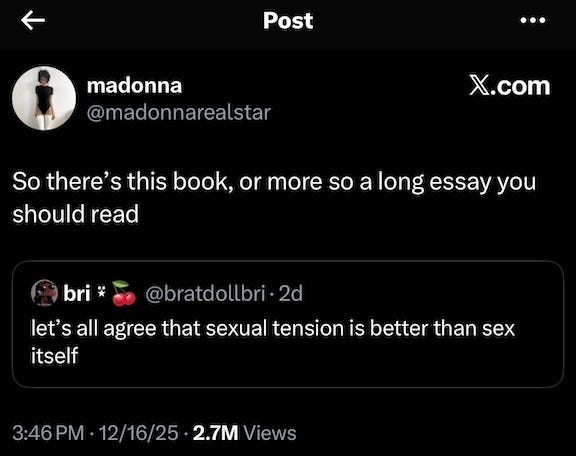
I was gripped by the essay. She describes eros as requiring a “seductive unattainability”. I thought of this unattainability as a veil, but also a gorge separating where we are and what we want.
Was all desire dependent on unattainability? I wondered.
I want to switch gears for a moment:
During a press interview for the film The Drama, Robert Pattinson was asked if he was Team Edward or Team Jacob, referring to the famous love triangle in Twilight. Pattinson said, laughing, “No one’s Team Jacob; that was just a marketing thing.”

It was a marketing thing, and why was it so effective? Why are we so enticed by a love triangle? I think because it’s the foundation of desire. All romantic love is a triangle.
Desire must reach (toward) but never reach (arrive). There must exist this gap, this place in between the lover and the object of desire. Something must stand in its way. Another lover? Can be, but not necessarily. The third angle could also be social or moral restrictions, class differences, geographic distances, or familial loyalties and obligations— Romeo and Juliet is a love triangle.
No matter what, a space must be maintained or desire ends.
But what is the function of the love triangle?
When I was growing up, love triangles were almost a staple of teen shows. I think the media was teaching us how desire works. We learn how to desire by watching other people after all.1 Love triangles are a good embodiment of tension in storytelling and a foundational structure of erotism. Film/TV were among the first places I was confronted with the love triangle and made to understand the essence of desire. I understood that there was such a thing as wanting and not getting, and that this dichotomy was its own kind of satisfaction. The love triangle is a trope, sure, but it’s also a very simple geometric formula for erotism. By keeping the desire triangulated, the characters get to live in that heightened, transgressive state of continuous yearning. The tension is the source of pleasure.
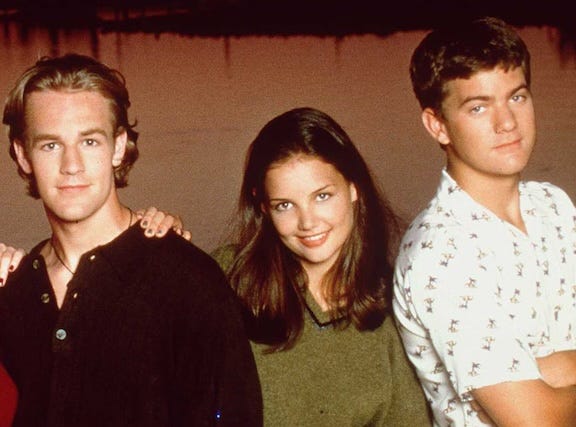
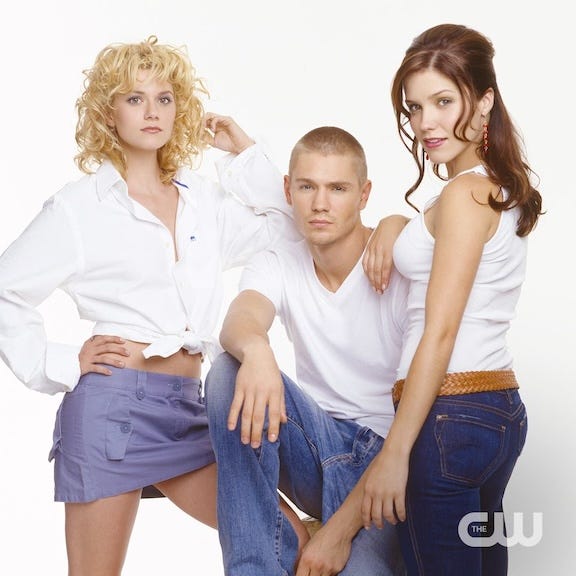
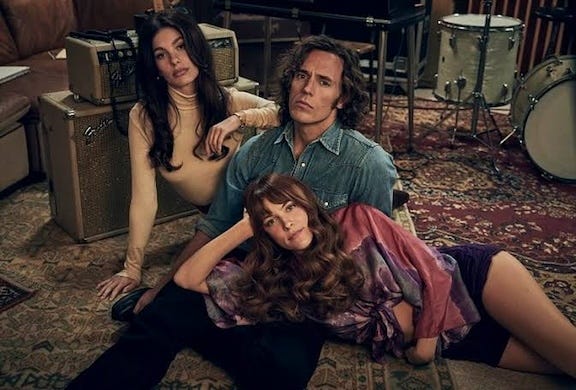

In keeping with the vampire theme, a memory ingrained in my brain forever is the Season 2 promo for The Vampire Diaries, which featured Florence and the Machine's “Cosmic Love” and truly encapsulated desire and its tensions. I was obsessed with the commercial. The three of them seemed content with their place in the triangle; each served a function.
In Eros the Bittersweet, Anne Carson says that eros forms a geometrical figure.
But who’s Eros? The ancient Greek god of love, desire, and passion is, according to Freud in Beyond the Pleasure Principle, the will to live.2 Anne Carson says Eros is a certain lack. These may sound like opposing views, but they aren’t, since desire moves us along a path reserved for the living, and its destination threatens an end.
The Greek word eros denotes “want”, “lack”, or desire for what is missing.3 Within this passion, we have an inherent lack. The lack is necessary. Surely we know that wanting something depends on not having it, but what is harder to come to terms with is that this tension is the pleasure itself. The tension’s the thing! We want the wanting more than the getting. The wanting is the thing that transforms, it’s the alchemical substance that moves us along existence. “The self forms at the edge of desire and a science of self arises in an effort to leave that self behind,” writes Carson. We want to be transformed by our desires, and we can only truly desire that which we do not possess. This is the WILL TO LIVE!4
I’m at pilates, and my instructor is yelling, “Keep the tension going in that left leg, the tension is what creates that change!” Ok!
In examining one of Sappho’s best-known love poems (fragments 31), Carson comes to the conclusion that Sappho realizes desire as a “three-part structure”5 and that this structure is a “cognitive and intentional necessity”. Yay!
We may, in the traditional terminology of erotic theorizing, refer to this structure as a love triangle, and we may be tempted, with post-Romantic asperity, to dismiss it as a ruse. But the ruse of the triangle is not a trivial mental maneuver. We see in it the radical constitution of desire. For, where eros is lack, its activation calls for three structural components-- lover, beloved, and that which comes between them.
Desire requires distance.
For Bataille, the triangle of erotism is a sort of taboo. “Desire in eroticism is the desire that triumphs over the taboo. It presupposes man in conflict with himself.”6 Here’s another triangle: an individual, their desire, and the taboo. Rules, prohibitions, and boundaries are what actually create erotic desire. The erotic charge vanishes if we’re allowed to get what we want.
Romantic desire is fundamentally a paradox of distance.7
In The Age of Innocence, Newland Archer doesn’t want to be with Countess Olenska; he just wants to be in a state of desire. His world has everything except desire, and Olenska provides that for him. It’s not that they don’t want to be together; it’s that being together will put an end to eros. “I can’t love you unless I give you up,” she says.
What happens if we despise this tension? Are there any pathologies that don’t take erotic pleasure in the triangulation of desire? Certainly! I think it’s the melancholic. The melancholic is tragically aware of this triangle. For the melancholic, the tension has been released and has transformed into loss. Melancholy is the last triangle we’ll look at today.
In 1917's "Mourning and Melancholia," Freud attempted to explain melancholy. His essay provides an important framework for the complex relationship between melancholy and ideas of loss. This is where melancholy differs from mourning, since instead of slowly getting over the loss of the “loved object”, it stubbornly refuses to give it up, leading the melancholic to be in constant engagement with this loss. It’s not a coincidence that Freud uses the term “libido” to describe this attachment.8
Rick from Casablanca is melancholic because he’s rejected desire, too. When Ilsa rejected him, he rejected his desire, for her, yes, but also for the resistance, his desire to fight against the Nazis. A true melancholic.
In Stanzas, Agamben argues. "Melancholy would be not so much the regressive reaction to loss of the love object as the imaginative capacity to make an unobtainable object appear as if lost." What we can gain from this perspective is the melancholic's self-protection in the way it views the inaccessible object. The melancholic has taken its erotic attachment to the object and has transformed it into loss. By rendering it as "lost," the inaccessible object is much more easily dealt with. Agamben's analysis of melancholia's association with the inaccessibility or unobtainability of an object (the word "object" used very loosely in this context) provides us with an understanding of both the presence of desire in melancholia and its recognition of roadblocks in our way. In other words, there exists a perception of paths that have yet to be paved in order to gain access to the inaccessible, but the melancholic can’t be bothered. It’s desire bent backward. A good film that illustrates this is La Chimera, or, for that matter, the myth of Orpheus and Eurydice.
It seems to me that we wish to protect the lack that sustains us. We want to keep the object out of reach. Give me exquisite torture or give me death!
Both René Girard and Lacan talk about this.
Freud, Sigmund. Beyond the Pleasure Principle (1920)
Carson, Anne. Eros the Bittersweet. Princeton University Press, (1986) pg. 10
Even the manifestation girlies on TikTok tell us, “if you want to have something you have to believe you already have it, because if you keep wanting it you keep telling the universe that you don’t have it, and you’re in a state of lack,” But don’t they know that wanting’s the whole point? Most people don’t actually want to get what they want.
Carson, Anne. Eros the Bittersweet. Princeton University Press, (1986) pg. 16
Bataille, Georges. Erotism: Death and Sensuality (1957).
Jacques Lacan defined desire as the fundamental, unconscious drive of human existence, born from the gap between our basic biological needs and our ability to articulate them through language. It is not a pursuit of a concrete object, but an endless search to reclaim a lost sense of wholeness.
Freud, Sigmund. "Mourning and Melancholia," (1917).
I was explaining this essay to a bunch of 20-somethings at Tribeca and they were listening like I was God. You have something special here!
Does the melancholic presume loss when initially feel desire? And does that fear of rejection become the third point in the triangle?
love how committed you are to the subject 💘